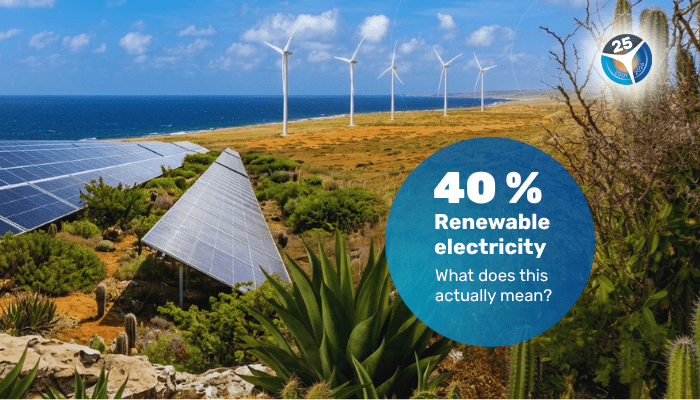
Preliminary figures for the first five months of 2026 put the share of renewable electricity in Curaçao at around 40%. This points to clear progress toward the target of at least 50% by 2035.
But what does this percentage actually represent? To understand that, it helps to look at how this share is calculated.
Where does this percentage come from?
The share of renewable electricity is determined by the production mix: the ratio between electricity generated from wind and solar sources, and electricity generated from fossil fuels.
This ratio is based on actual production during the period being measured, and it determines what portion of total electricity output counts as renewable. It is worth noting that electricity that consumers and businesses generate and consume themselves through their own PV installations (solar) is not included in this figure. However, electricity that these end users feed back to Aqualectra is included.
What does the percentage show, and what does it not show?
The percentage gives a reliable picture of how electricity production in Curaçao was divided between renewable and conventional sources during a given period. It does not, however, tell the full story of the underlying structure of the energy system.
For example, the renewable electricity share does not show how much capacity is available. Capacity indicates how much energy could theoretically be generated, while the renewable share is based on what was actually produced. The difference becomes clear when capacity and production are compared side by side.
According to the most recently published figures (2024), Curaçao’s wind farms have a combined capacity of 69 megawatts (MW), compared to 151 MW of conventional generation capacity. This capacity did not change in 2025. In that same year, 2024, wind energy accounted for 21% of electricity production. Registered PV installations, meanwhile, had a combined capacity of approximately 16.6 MW in 2024.
The renewable share, then, is shaped not primarily by available capacity but by how much electricity is actually produced in a given period. That production, in turn, depends on how much wind (which is seasonal) and how much sunlight (available only during the day, and varying in intensity due to cloud cover) is available over the course of the year. Regardless of these variations, renewable electricity is always prioritized in the production mix, meaning that available renewable electricity is supplemented with electricity from fossil sources as needed to meet total demand.
Energy production: more than electricity alone
Electricity is just one part of Curaçao’s broader energy system. Fuel consumption, drinking water production, and energy infrastructure all play a role in how energy is produced and used. For a broader and more integrated view of the energy sector, including how these different components relate to one another, consult the Energy Report 2024.
Developments and figures for 2025 will be published in the next Energy Report, in the last quarter of 2026.
(Sources: RAC, based on preliminary 2026 production data (Aqualectra) | Energy Report 2024)
Related Publications

Key findings IPC Global Postal Industry Report 2016

Tariffs electricity and water as of 1 July 2023