
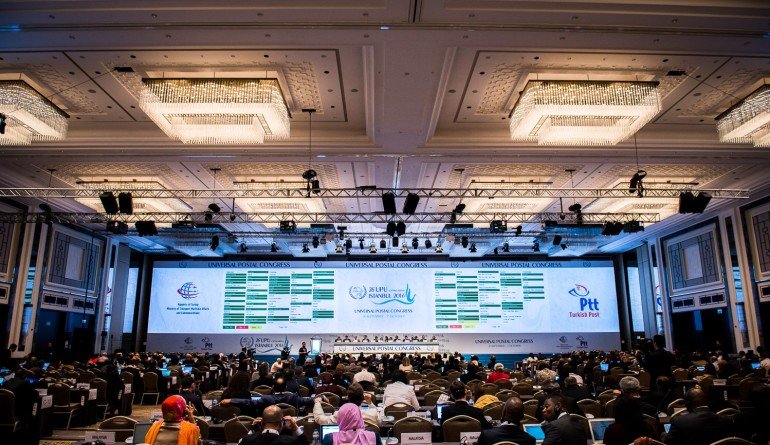
From September 20 till October 7, 2016, Turkey Istanbul was the setting for the 26th Universal Postal Union (UPU) Congress during which the draft World Postal Strategy for 2017 – 2020 was adopted, commencing in 2017.
Over 2000 delegates of 155 countries from each of the world’s regions convened during this year’s UPU Congress. Bureau Telecommunicatie & Post was also present as a multi-disciplinary regulatory authority represented by its Managing Director, Franklin Sluis.
The objective of the Congress was to lay a roadmap for the 2017 – 2020 work cycle, based on the draft Istanbul World Postal Strategy. The roadmap is designed to address critical issues facing the postal sector. To this end more than 450 proposals were discussed.
With exponential growth of online services and a decline in traditional mail services among the main challenges facing the Post, the 26th UPU Congress discussions focused on transforming postal services to meet changing customer demands and strengthening the postal network.
Modern technology has for some time seemed a threat to the existence of the Post, but thanks to innovation in the industry, the Post is turning the situation to its advantage by diversifying its products to fit the new demands.
The proposed 4-year World Postal Strategy has been shaped in the light of current technological developments, innovations in the communication sector, common needs and several current issues faced by the postal sector. The strategy is aimed at developing the operational structure of the postal network, the appearance, use and continuation of use of sustainable and modern products and effective market operation, while putting an emphasis on the principles of innovation, integration and comprehensiveness.
World Postal Strategy goals: foundation for postal Vision 2020
The Istanbul World Postal Strategy for 2017 – 2020 emerged from a series of high-level conferences that took place in 2015 in regions around the world, as well as discussions during regional sessions of the UPU’s Council of Administration.
The postal sector is still facing a new frontier with the development of new technologies, increased
e-commerce demand and emergence of new competitors. Moreover, rapidly changing technologies have created new market realities that are driving alternative service options and a new set of customer expectations.
As a result, the Post and the UPU are in the spotlight; they must now, more than ever, evolve to remain relevant. Societies are changing by the day and technologies are causing disruption to the way business is conducted. Therefore agility and flexibility are required in the way the Post is doing business as well. The adopted World Postal Strategy contributes to this as it serves as a strategic roadmap for the UPU’s work in the 2017 – 2020 cycle, while centering on the following three goals:
- Improving the interoperability of the postal network infrastructure
- Ensuring sustainable and modern postal products
- Fostering market and sector functioning
The regional discussions that led to the strategy 2017 – 2020 involved a total of 157 countries or 82 per cent of the UPU’s total membership and included decision-makers ranging from ministers, regulators and CEOs, to general directors and heads of restricted unions.
A total of seven Regional Strategy Conferences revealed a common set of priorities that essentially covered the themes of innovation, integration and inclusion as central elements of the draft Istanbul World Postal Strategy, which culminates into a new cardinal vision for the postal sector in 2020, Vision 2020, consisting of the following three pillars for transformation of the postal sector:
- Innovation is shared, promoted and driven – not as a luxury, but as a reality for all
- Full integration of networks at the national, regional and global levels is a reality
- The postal sector’s unique ability to include populations, economic actors and territories is fully recognized and exploited by governments, development partners and international organizations
UPU & the Post: drivers for global development
Being mandated to ensure universal access to affordable public postal services of the highest standard, the UPU, as part of the United Nations, represents the interests of the worldwide postal sector.
In addition to maintaining a genuinely universal network – with physical, financial and electronic dimensions – it establishes the rules for international mail exchanges among its member countries and makes recommendations to modernize products and services, stimulate mail volume growth and improve the quality of service for customers.
On the other hand, the global postal network is a formidable infrastructure through which essential public services are provided to millions of citizens and businesses. This enables the postal sector to play a critical role in fueling countries’ social and economic development. Postal operators also provide financial, logistics and e-commerce services to countless customers to meet their evolving needs.
With this in view, within the context of the new digital age, characterized by disparities in global socio-economic conditions, the UPU can help to provide solutions geared towards social inclusion and to promote integration throughout the global postal network. Current activities are already helping the postal sector carry out its role as an essential component in the global economy. With the rise of digital technologies and e-commerce, customers expect postal operators to modernize their services and improve quality, making innovation a crucial necessity.
In line with this, at the UPU Ministerial Conference on 4 October, hosted during the Congress, Ministers from around the world thus agreed on the contribution of postal services in achieving the UN Sustainable Development Goals (SDGs). Guided by theme “Delivering sustainable development: Connecting citizens, businesses and territories,” Ministers reaffirmed during discussions the Post’s role as a driver of global development based on the following parameters:
- Financial inclusion: Post is using its far-reaching network to drive social and financial inclusion
- Trade & Economy: Post facilitates global trade, especially among small and medium sized enterprises
- Digitization: Post’s physical network plays an important role in connecting customers to the digital world and facilitating the transition to serving new younger markets
Looking ahead
In conclusion, new information and communications technologies and e-commerce booming, represent the new context within which the Post has the opportunity to increase its relevance in the future as the trusted intermediary and vehicle that connects governments, citizens, businesses and territories.
The deliberations and discussions during the Congress have led to decisions that will help fortify the global postal network and businesses and citizens have been able to determine the benefits they can derive from financial, logistics and e-commerce services in the future.
In addition to the World Postal Strategy, UPU Member countries also adopted the Istanbul Business Plan, which guides the implementation of the Istanbul World Postal Strategy by setting all work proposals, targets and financials for carrying out the strategy’s goals.
The Business Plan will be finalized, taking into account all adopted work plans and decisions made during Congress regarding the UPU budget.
The Istanbul Congress designated Côte d’Ivoire as the host of the 27th Universal Postal Congress in 2020. It will take place in Abidjan. In the meantime an extraordinary Congress will be held in 2018, where unresolved issues from the 26th Congress, such as the reform of the UPU, will be debated. This event will be hosted in Addis Abeba, Ethiopia.
(Source: http://www.upu.int/. BT&P Publication period: 2016)